I didn't want to build another CRUD application just to add a project to my portfolio. I wanted to build a product that solved a real problem, required real engineering decisions, and forced me to think beyond individual API endpoints.
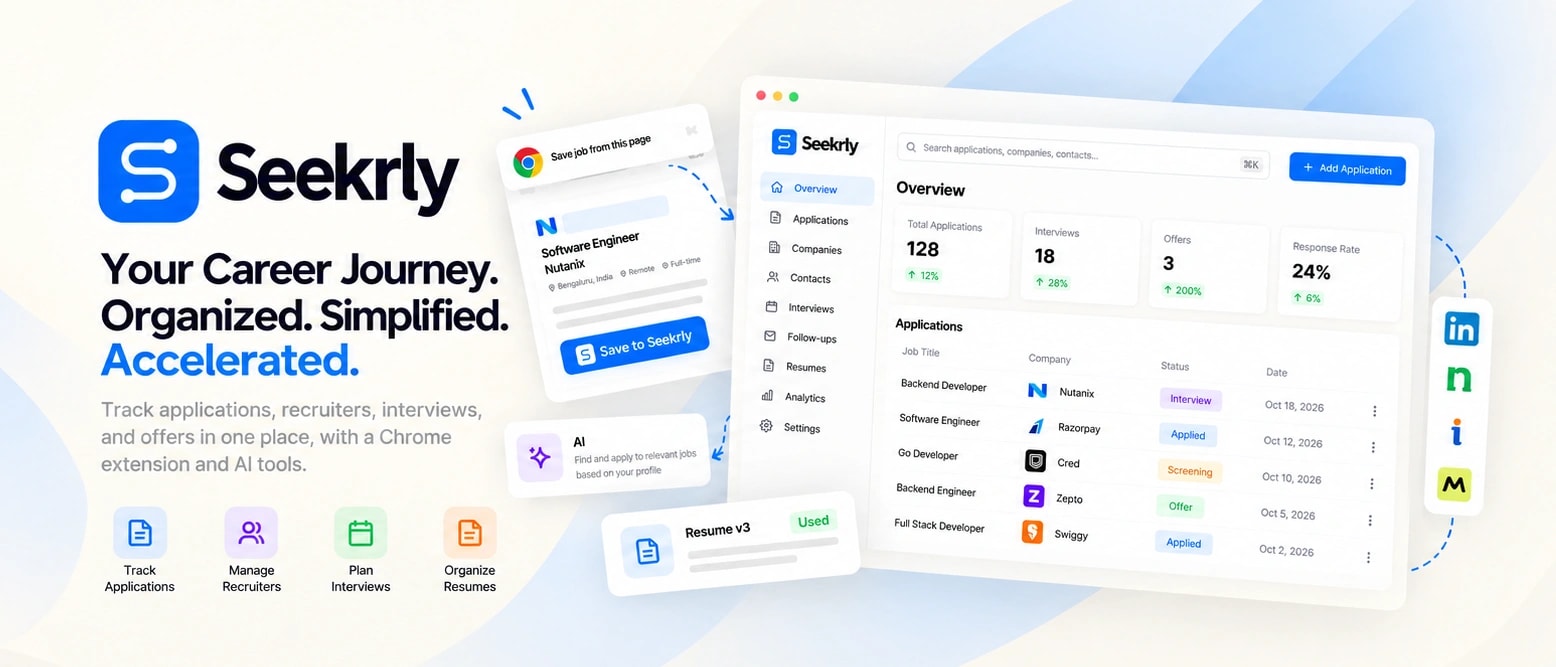
That became Seekrly: an AI-powered career management platform that helps job seekers organize applications, save opportunities, manage resumes, assess job fit, and prepare for interviews. Over 500+ hours of building and iterating, I worked across the product, backend services, AI workflows, integrations, and infrastructure.
The interesting part wasn't simply adding features. It was figuring out how to make different services work together, move expensive work out of request handlers, protect user data, and keep background processing reliable as the product grew.
The Problem: A Job Search Is a Workflow, Not a Spreadsheet
A job search involves multiple disconnected activities: discovering roles, saving job descriptions, tailoring resumes, tracking applications, communicating with recruiters, and preparing for interviews. Keeping everything organized across job boards, spreadsheets, documents, and browser tabs creates unnecessary overhead.
Seekrly brings these activities into one platform. Users can save job opportunities, organize their application pipeline, manage resumes, and use AI-powered tools to make their job search more targeted.
From an engineering perspective, these features create different workloads. Saving an application needs a quick response. Parsing a resume or generating interview questions can take longer, consume model resources, and fail for reasons outside the application's control. Treating every operation as a synchronous API request would make the system harder to operate and scale.
Architecture: Separate Responsibilities, Share Business Logic
Seekrly evolved into a multi-service application. Instead of forcing every responsibility into a single backend process, I separated the user-facing application, core backend functionality, background processing, and AI execution into components with clearer responsibilities.
The key design decision was to separate responsibilities without unnecessarily duplicating business logic. Multiple entry points should not develop their own conflicting versions of the same rules.
The Shared Service Layer: One Set of Rules
As a product grows, the same business operation may be triggered from the web application, an API client, a browser extension, or an external integration. Implementing the same operation separately in every entry point creates inconsistency and increases the chance of security bugs.
I structured the backend around reusable service-layer operations so that different interfaces could invoke the same business logic rather than independently implementing database access and application rules.
This approach makes adding another integration less expensive. A new interface can reuse established operations instead of becoming another independent implementation of the product's business rules.
The AI Worker: Keeping Expensive Work Out of Request Handlers
One of the most important architectural decisions was giving AI processing its own worker instead of mixing model execution directly into the main application request lifecycle.
Seekrly's AI features handle documents, job descriptions, user context, and generated content. Model calls can be slow, return malformed output, encounter rate limits, or fail temporarily. They also have different compute and cost characteristics from ordinary CRUD operations.
A dedicated AI worker creates a boundary between accepting an operation and executing it. The application can validate and enqueue eligible work, while the worker handles processing, model communication, retries, and result persistence.
AI Features Built Around Real Job-Search Tasks
These are not all the same AI task. Resume parsing needs structured extraction; job fit scoring needs a consistent comparison; interview preparation needs useful, role-specific content. Keeping them within a common processing system allows shared infrastructure while preserving feature-specific instructions and output validation.
How the AI Processing Pipeline Works
The worker follows a controlled processing flow rather than treating every model response as trustworthy output.
This pipeline matters because AI reliability is not just a prompt-engineering problem. It also involves input boundaries, usage accounting, model failures, output validation, sensitive data, and the lifecycle of a background job.
Redis Streams and Reliable Background Processing
Background jobs introduce their own failure modes. A worker can crash after receiving a task. A model provider can time out. A process can restart before the result is saved. Simply putting work in a queue does not automatically make the system reliable.
Seekrly uses Redis-based queueing and stream processing to coordinate asynchronous work. Consumer groups provide a foundation for distributing tasks across worker instances and managing pending messages.
The important distinction is that queue delivery and business-operation completion are not the same thing. A robust worker must account for what happens when execution stops between those two events.
Scheduled Jobs and Idempotency
Not every background task starts with a user request. Scheduled workflows also need to run at the right time, avoid duplicate execution, and recover from missed runs or service interruptions.
For scheduled processing, I use atomic claiming and idempotency-oriented design to reduce the risk of two workers executing the same logical operation. Catch-up and sweep mechanisms help account for work that was missed while a service was unavailable.
These mechanisms are important for any SaaS product with reminders, recurring tasks, notifications, or time-dependent workflows. They also force you to define what a successful operation means and how the system should behave after a partial failure.
More Than a Web App: Chrome Extension, APIs, and MCP
Seekrly is designed to fit into the user's existing job-search workflow rather than requiring every interaction to begin in the web dashboard.
Chrome Extension
The browser extension helps users capture job opportunities while browsing job sites. This creates an integration boundary between external pages and Seekrly's application data, where input normalization, authentication, and consistent backend rules matter.
REST API
An API provides a structured way for supported clients and integrations to interact with Seekrly. Reusing backend services keeps API behavior aligned with the core application instead of creating a separate set of business rules.
MCP Integration
Seekrly also supports an MCP integration, enabling compatible AI clients to interact with supported job-search workflows through tools. This introduces additional engineering concerns beyond exposing an endpoint: authentication, authorization scopes, clear tool contracts, and safeguards around operations that modify user data.
For sensitive or destructive operations, a safer integration should make the requested action and its consequences clear rather than allowing an external agent to silently perform unrestricted changes.
Security and Data Handling
A career platform stores information that users expect to remain private, including resumes, employment history, contact information, and application details. Security therefore needs to be part of the architecture, not a final checklist.
The goal is to minimize unnecessary exposure while keeping the product useful. In an AI-enabled application, that means thinking about the complete data path: upload, processing, model request, output storage, and eventual deletion.
Infrastructure and Operations
I also worked on deploying and operating the application, using Docker-based services and a self-managed cloud environment. The stack includes application services, MongoDB, Redis, and integrations for email delivery and other product workflows.
Running multiple services introduces operational work that is easy to overlook when building only a local prototype: configuration management, service connectivity, persistent storage, credentials, logs, restarts, and debugging failures across process boundaries.
I approached infrastructure as part of the product rather than treating deployment as a one-time step. The objective was to make the system understandable and maintainable while keeping the operating setup appropriate for an independently built SaaS.
Engineering Trade-offs and Lessons
1. A Monolith Is Not the Enemy; Unclear Boundaries Are
Splitting every feature into a separate service creates deployment and debugging overhead. The useful separation is where workloads, responsibilities, or failure modes differ. The dedicated AI worker is valuable because AI execution has distinct operational needs, while shared business services reduce unnecessary duplication.
2. Asynchronous Processing Requires Failure Design
Moving a task to a queue is only the beginning. You also need to decide how to retry, when to acknowledge work, how to recover abandoned messages, and what to do with permanently failing tasks. These decisions determine whether background processing is dependable.
3. AI Features Need Software Engineering Around the Model
The model is one component in a larger system. Input validation, privacy, cost controls, structured output, error handling, and persistence all influence the quality and reliability of an AI feature. A clever prompt cannot replace those engineering controls.
4. Integrations Multiply the Importance of Consistent Rules
A web dashboard, browser extension, REST API, and MCP client may all trigger related actions. Centralizing business logic and enforcing authorization consistently makes it easier to add interfaces without weakening the product's security model.
5. Building the Product Changes How You Think
Building Seekrly required me to think about more than writing code that works on the happy path. I had to consider service boundaries, failure recovery, data ownership, integration contracts, operational complexity, and the trade-offs between shipping a feature and maintaining it.
What This Demonstrates About My Backend Engineering
Seekrly is a practical example of the kind of backend work I want to continue doing: building systems that support real product workflows, separating asynchronous and resource-intensive workloads, designing reusable service layers, integrating AI capabilities, and operating a multi-service application.
I am especially interested in backend engineering roles at startups where engineers take ownership of systems end to end: from API contracts and data models to workers, infrastructure, reliability, and production debugging.
What’s Next
Building Seekrly has given me hands-on experience taking a product from idea to deployment—from backend architecture and asynchronous workers to AI integrations and infrastructure.
I'm interested in backend engineering opportunities where I can take ownership of meaningful technical problems, work closely with a small team, and help build products that scale with their users.
Explore the Engineering Behind Seekrly/project/seekrly(opens in a new tab)